

If you’re still manually scrolling through hundreds of keyword suggestions in spreadsheets, you’re already behind. The game has changed. AI keyword research isn’t about replacing your expertise; it’s about amplifying it. UK brands that have adopted intelligent keyword strategies are discovering profitable long-tail opportunities their competitors haven’t even considered yet.
The traditional approach? Pick a seed keyword, export 500 variations, guess which ones matter, and hope for the best. It’s time-consuming, often inaccurate, and leaves money on the table. The smarter approach uses AI to identify semantic relationships, cluster topics by intent, and surface high-value keywords with genuine conversion potential.
This guide shows you exactly how to master AI keyword research for UK brands, without falling into the trap of generic, robot-generated content that Google’s helpful content system penalises. Let’s dive into the framework that’s helping British businesses dominate their niches.
If you’re exploring how AI can transform more than just keyword research, our AI SEO services for UK brands break down exactly how to apply this across your entire search strategy.”
Key Takeaways
- AI keyword research reduces research time by 70-80% which takes 6-8 hours manually now takes 1-2 hours with intelligent automation
- Semantic clustering groups related keywords by topic and intent, helping you build topical authority instead of chasing isolated terms
- Long-tail keywords with low competition deliver higher ROI than high-volume vanity metrics everyone else targets
- AI identifies search intent patterns automatically, know whether users want information, comparisons, or are ready to buy
- UK-specific tools and data sources are essential to capture British terminology, regional nuances, and GDPR-compliant insights
- Human oversight prevents generic AI content, use AI for speed and discovery, apply your expertise for quality and relevance
- Quick wins exist in low-difficulty, high-relevance keywords that competitors overlook; AI surfaces these opportunities in minutes
- Topical authority beats keyword stuffing, and comprehensive content clusters signal genuine expertise to Google’s algorithm
Table of Contents
Why Traditional Keyword Research Is Failing UK Brands
Most keyword research strategies are stuck in 2015. You’re targeting high-volume terms everyone else wants, ignoring search intent, and missing the long-tail goldmines hiding in plain sight.
The old method looked like this: Find a keyword with decent volume, check the difficulty score, add it to your content calendar, and pray. But Google’s algorithm doesn’t care about volume anymore. It cares about relevance, context, and whether your content genuinely answers what searchers need.
UK businesses face unique challenges too. You’re competing in a sophisticated market where generic American SEO advice doesn’t translate. British search behaviour includes local terminology, “holiday” not “vacation,” “mobile” not “cell phone”, and regional nuances that standard tools often miss.
Plus, there’s the time factor. Manual research for a single topic cluster can take 6-8 hours. Multiply that across your content calendar, and you’ve lost weeks of productivity. Meanwhile, your competitors using AI tools for SEO are identifying opportunities in minutes and publishing, whilst you’re still planning.
How AI Transforms Keyword Research From Guesswork to Strategy
AI doesn’t just speed up keyword research; it fundamentally changes what’s possible. Modern AI systems analyse billions of search queries, identify semantic relationships humans would miss, and predict which terms will drive actual business results.
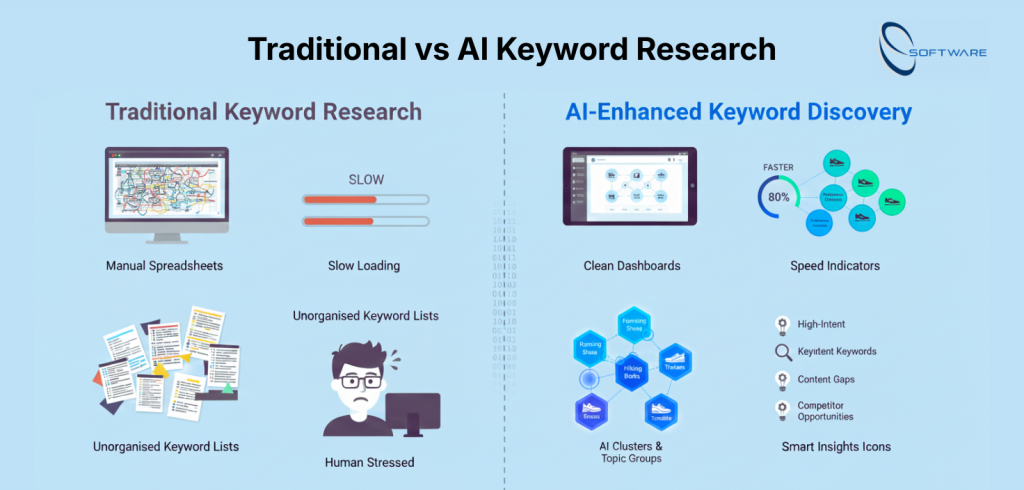
Here’s what semantic SEO powered by AI delivers: Instead of seeing “running shoes” and “trainers” as separate keywords, AI understands they’re related concepts. It clusters them with “athletic footwear,” “jogging shoes,” and “sports trainers” into a topical authority structure that Google rewards.
The technology excels at three critical tasks. First, semantic analysis reveals how search engines actually understand language. AI maps relationships between terms, identifies entities and concepts, and shows you the complete topic landscape, not just isolated keywords.
Second, keyword clustering AI automatically groups related terms by intent and topic. You might input 500 keywords and get back 15 content clusters, each representing a distinct user need. This prevents cannibalisation and helps you build comprehensive topic coverage.
Third, AI provides unprecedented competitor intelligence. It analyses what’s ranking in UK SERPs, identifies content gaps your competitors haven’t filled, and reveals the exact semantic patterns Google rewards in your niche.
This is the same AI-led framework we use in our AI SEO services at S Software Ltd to unlock quick wins and long-term authority.
The UK-Specific AI Keyword Research Framework
Successful AI keyword research for British brands requires a structured approach. Here’s the exact framework we use at S Software Ltd to help UK companies dominate their markets.
Step 1: Define Your Strategic Foundation
Start with business objectives, not tools. What are you actually trying to achieve? More qualified leads? Higher-value customers? Better conversion rates? Your keyword strategy flows from these goals.
Next, map your customer journey. Different keywords serve different stages. Someone searching “what is email marketing” has informational intent; they’re learning. Someone searching “enterprise email marketing platform pricing UK” has strong commercial intent; they’re ready to buy.
Define your UK-specific context too. Are you targeting London businesses or regional markets? B2B or B2C? The nuances matter because search behaviour varies significantly across British regions and industries.
Step 2: Deploy AI for Seed Keyword Expansion
Feed your AI tools strategic seed terms related to your core offerings. But don’t just use obvious ones. Include industry jargon, problem statements, and questions your customers actually ask.
Tools like Semrush and Ahrefs now offer AI-powered keyword expansion that considers UK-specific data. They’ll generate hundreds of semantically related terms, but here’s the crucial part: you need to filter intelligently. Volume isn’t value.
Look for long-tail keywords AI surfaces that have lower difficulty scores and clear intent signals. A term like “how to improve local SEO for UK solicitors” might have only 90 monthly searches, but if you’re targeting solicitors, those 90 searches are pure gold.
Step 3: Apply Semantic Clustering for Topic Authority
This is where AI really shines. Rather than targeting individual keywords, you’re building topical clusters that establish genuine authority. AI clustering tools analyse your keyword list and organise terms into logical content groups.
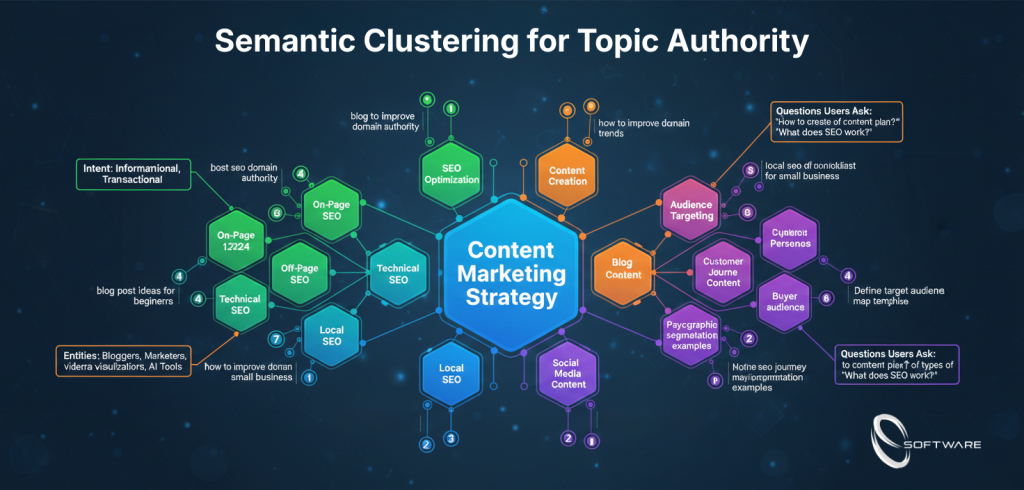
For example, if your seed term is “technical SEO,” AI might create clusters for site speed optimisation, crawlability issues, structured data implementation, and mobile performance. Each cluster becomes a pillar page with supporting content.
The benefit? Google increasingly rewards depth over breadth. A comprehensive cluster covering every aspect of technical SEO signals expertise far better than 20 shallow blog posts about random keywords.
Use GPT keyword prompts to explore each cluster further. Ask AI to identify common questions, pain points, and information gaps within specific topics. This reveals content opportunities competitors haven’t addressed.
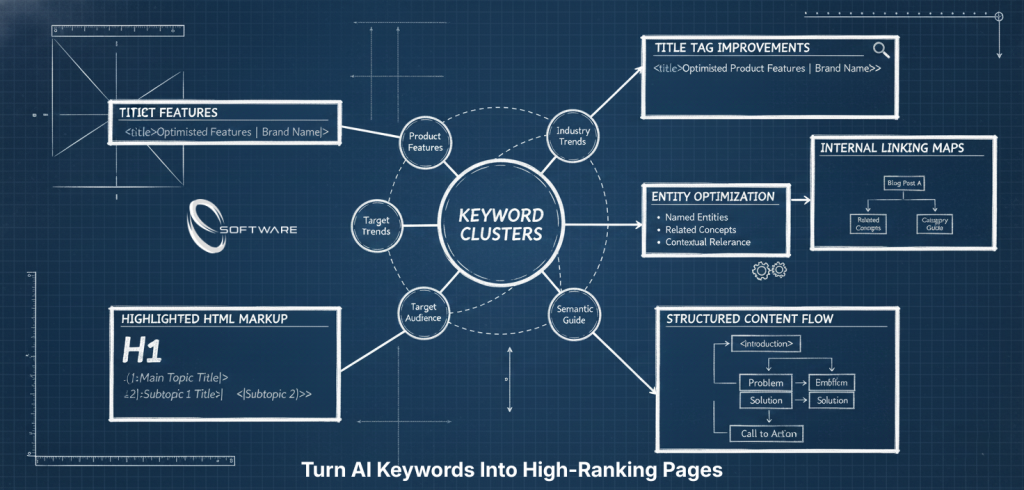
Once your AI keyword research and clusters are in place, your content still needs careful optimisation; headlines, internal links, and on-page structure all matter. That’s where our on-page SEO services help turn keywords into rankings and conversions.
Step 4: Analyse Search Intent with AI Precision
Here’s where most strategies fail: they ignore why people search. AI excels at intent classification because it can analyse SERP features, content patterns, and user behaviour at scale.
For any keyword, AI can determine whether the intent is informational (learning), navigational (finding a specific site), commercial investigation (comparing options), or transactional (ready to purchase). This determines your content approach entirely.
A keyword like “AI SEO tools UK” shows mixed intent. Some searchers want reviews and comparisons (commercial investigation), others want tutorials (informational). AI helps you spot these nuances and create content that serves the actual need.
Check what’s currently ranking in UK Google for your target terms. AI tools can analyse the top 10 results and tell you exactly what content format, depth, and angle Google favours for that query.
Step 5: Prioritise Based on Opportunity, Not Vanity Metrics
This is your competitive advantage. Whilst others chase high-volume keywords, AI helps you identify low-competition opportunities with disproportionate value.
Look for terms where keyword difficulty is low but relevance to your business is high. These “quick wins” let you build authority progressively. A financial services client of ours ranked for 23 long-tail terms within six weeks using this approach, driving qualified leads immediately.
Consider SERP volatility, too. AI can identify keywords where rankings fluctuate frequently; these represent opportunities to claim positions competitors haven’t locked down.
Factor in UK-specific commercial value. A keyword might have lower volume, but if it targets high-intent UK buyers in your exact niche, it’s worth prioritising over generic high-volume terms.
Essential AI Tools for UK Keyword Research
The tools matter, but strategy matters more. Here are the platforms we recommend for UK-focused keyword research, each serving specific needs.
Semrush offers comprehensive UK keyword databases and excellent semantic analysis. Its Keyword Magic Tool generates thousands of variations, whilst the Topic Research feature builds content clusters automatically. The UK-specific data is reliable because it draws from genuine British search behaviour.
Ahrefs excels at competitor analysis and content gap identification. Its Keywords Explorer provides accurate UK search volumes and shows you exactly which keywords your competitors rank for that you don’t. The “Parent Topic” feature helps avoid cannibalisation.
Google Keyword Planner remains essential for UK PPC data that reflects actual search demand. Filter by the United Kingdom and review the suggested terms Google itself recommends; these insights come straight from the source.
Emerging AI platforms like ChatGPT and Claude are powerful for semantic expansion when used correctly. Feed them your niche, target audience, and pain points, and they’ll generate question-based keywords and topic angles you hadn’t considered.
For GDPR-compliant data analysis, ensure any AI tool you use clearly states how it handles UK customer data. This isn’t optional; it’s a legal requirement that protects both you and your audience.
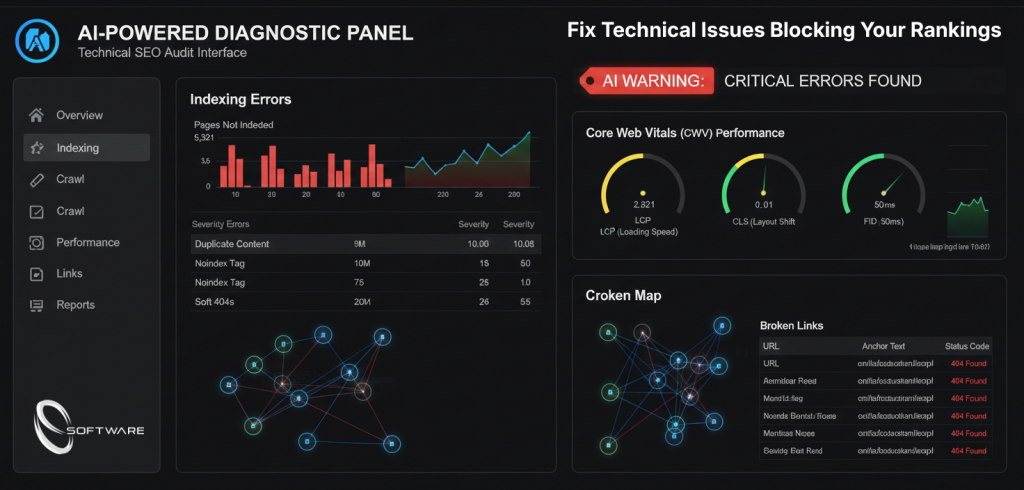
If your pages aren’t being indexed or your site has Core Web Vitals issues, even the best AI keyword research won’t save you. Our technical SEO services fix the foundations so your AI-driven content can actually rank.
Avoiding the AI Keyword Research Pitfalls
AI amplifies good strategy and bad strategy equally. Here’s how UK brands go wrong and how to avoid these costly mistakes.
The biggest error? Trusting AI blindly without human validation. AI might suggest “trainers” as relevant when you sell enterprise software. It lacks business context unless you provide it. Always filter suggestions through your actual business goals and customer knowledge.
Generic content is another trap. AI can generate keyword lists efficiently, but if you then use AI to write generic content around those keywords, you’ve wasted the research. Google’s helpful content system specifically targets AI-generated fluff that doesn’t provide genuine value.
Ignoring local nuances costs UK brands their rankings. AI trained primarily on American data might miss British terminology, regional variations, or UK-specific search patterns. Always validate suggestions against actual UK search behaviour.
Over-optimisation remains a risk too. Just because AI found 50 related keywords doesn’t mean you should cram them all into one piece. Focus on natural language that serves readers first, search engines second.
Finally, forgetting about E-E-A-T (Experience, Expertise, Authoritativeness, Trustworthiness) undermines even the best keyword strategy. AI can find opportunities, but you need genuine expertise to create content that ranks and converts.
Implementing Your AI Keyword Strategy: A Practical Roadmap
Implementing your AI Keyword Strategy Theory means nothing without execution. Here’s your step-by-step implementation plan for the next 30 days.
Week 1: Audit your current keyword targeting. Export everything you’re currently targeting and use AI clustering tools to identify gaps and overlaps. You’ll likely discover cannibalisation issues and missed opportunities immediately.
Week 2: Build your topic clusters. Use AI to organise your keywords into 5-10 core topic areas. Create a content map showing pillar pages and supporting content. This becomes your authority-building blueprint.
Week 3: Prioritise quick wins. Identify 10-15 low-competition keywords AI surfaced that you can realistically rank for within 90 days. Create optimised content targeting these terms first.
Week 4: Implement and measure. Publish your content, track rankings and traffic, and feed results back into your AI analysis. The beauty of AI is that it learns your strategy and gets smarter with every iteration.
Throughout this process, maintain the human element. Use AI for speed and scale, but apply your industry expertise to ensure relevance and quality. That combination is what separates brands that rank from brands that dominate.
If you don’t have the time or team to manage this yourself, S Software Ltd can run AI-led keyword research and clustering for you, then hand over a clear content roadmap tailored to your UK market.
Staying Compliant: GDPR and Ethical AI Use
UK brands can’t afford to ignore data privacy. When using AI for keyword research, especially tools that analyse customer data or search behaviour, GDPR compliance isn’t optional.
Ensure any AI platform you use clearly documents where data is stored, how it’s processed, and whether it meets UK data protection standards. Tools that process data outside the UK require additional scrutiny.
Be transparent about AI use in your content creation process. Whilst AI-assisted research is perfectly acceptable, content should always be reviewed, edited, and validated by human experts. This isn’t just ethical, it’s what Google rewards.
Never use AI to scrape competitor data in ways that violate terms of service or data protection laws. Analyse public SERP data and published content, but respect boundaries. Ethical SEO builds sustainable rankings.
Conclusion: Your Competitive Advantage Starts with Smarter Research
AI keyword research isn’t the future; it’s the present. UK brands using intelligent automation to identify high-value opportunities, build topical authority, and serve genuine search intent are already winning. The question isn’t whether to adopt these methods, but how quickly you can implement them.
The framework in this guide gives you everything needed to transform keyword research from a time-consuming guessing game into a strategic competitive advantage. Start with small wins, validate results, and scale what works.
Ready to discover the high-value keywords your competitors are missing? S Software Ltd specialises in AI-powered SEO strategies tailored specifically for UK brands. Our frameworks combine cutting-edge AI tools with deep SEO expertise to deliver rankings and revenue, not just traffic. Let’s build your keyword strategy together.
Frequently Asked Questions
How does natural language processing improve long-tail keyword discovery?
NLP analyses conversational search patterns and question-based queries that traditional tools miss, identifying how real users phrase problems and seek solutions. This reveals long-tail opportunities matching voice search and featured snippet formats, particularly valuable for UK markets where conversational search is growing rapidly.
Can AI predict which keywords will increase in search volume?
Advanced AI models analyse search trend data, seasonal patterns, and emerging topics to forecast volume changes with reasonable accuracy. Tools monitoring UK news cycles, social media trends, and industry developments can identify opportunities 3-6 months before they peak, giving early movers a significant advantage.
How do you prevent keyword cannibalisation when using AI clustering?
AI clustering naturally prevents cannibalisation by grouping keywords into distinct intent-based topics, ensuring each content piece targets a unique user need. Validate by checking that pillar pages target broad informational terms whilst supporting content addresses specific questions or commercial queries within that cluster.
What’s the relationship between AI keyword research and entity SEO?
AI excels at entity recognition, identifying people, places, brands, and concepts within topics. Entity-based keyword research focuses on semantic relationships between entities rather than exact-match phrases, aligning perfectly with how Google’s knowledge graph understands and ranks content.
How does AI analyse SERP features to inform keyword strategy?
AI tools scan SERP features like featured snippets, People Also Ask boxes, and image packs to determine what content format Google favours for specific queries. This reveals whether to target snippets with concise answers, create visual content for image results, or develop comprehensive guides for standard rankings.
Can AI identify keyword opportunities from competitor content gaps?
Yes, AI performs content gap analysis by comparing your keyword rankings against multiple competitors simultaneously, identifying terms they rank for that you don’t. More sophisticated analysis reveals topics competitors mention superficially, where you could establish deeper authority.
How do you integrate AI keyword research with content briefs?
Export AI-identified keywords and clusters into structured content briefs that include target terms, semantic keywords, user intent classification, recommended content format, and internal linking suggestions. This ensures writers create strategically optimised content that serves both users and search engines effectively.
What role does search intent classification play in AI keyword strategy?
Intent classification determines whether keywords require informational blog posts, commercial comparison pages, or transactional product pages. AI accurately categorises intent at scale, preventing the common mistake of creating wrong content types for specific queries—a major reason many pages fail to rank.
Can AI optimise keyword strategy for voice search and AI Overviews?
AI identifies question-based keywords and conversational phrases optimised for voice search, whilst also surfacing snippet-worthy content opportunities likely to appear in Google’s AI Overviews. Focus on concise, authoritative answers to common questions formatted for easy extraction by AI systems.
How does AI handle multi-intent keywords with mixed SERP results?
AI identifies keywords with mixed intent by analysing SERP diversity, then recommends either creating comprehensive content serving multiple needs or splitting into separate pages targeting distinct intents. This nuanced approach maximises ranking opportunities for complex queries where user needs vary.